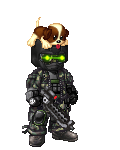
Infantry Ground Combat Armor System
The majority of the Armor is made from Dyneema, a high strength ultra-light weight polymer, with a higher hardness and strength than kevlar, making it ideal at stopping high velocity rounds. A material with good heat dissipation, environmental resistance, low friction and high strength, it serves as an ideal material for armor. At 1.2 pounds per square foot, the armor is capable of stopping level III-A threats, and 5.7mm and 4.6mm armor piercing rounds, as well as rifle rounds at long range. At 300-400 yards, the armor is capable of stopping 5.56mm, 7.62mm x 39mm, and 7.62mm NATO cartridges, and the armor also easily absorbs the energy of a shotgun blast or .44 magnum, as well as stops bladed or sharpened threats such as knives or ice picks. The high energy absorption combined with the hardness makes the armor more suitable against a variety of threats, from temperature, environment, falling, puncture or other threats, and armor piercing PDW rounds, as well as threats such as a 12 gauge shotgun which ordinarily will transfer enough kinetic energy to injure the user even through a level III-A vest. The armor is also resistant to UV, water, most chemical threats and high temperature, and succumbs less to fatigue, which when combined with a protective outer coating and material strengthens it from these threats further. The armor deforms less when impacted, and is resistant to higher velocity rounds, having a higher sheer velocity than kevlar. Over most of the body, it is capable of stopping armor piercing 5.7mm and 4.6mm rounds, handgun rounds, shotgun rounds, and low velocity rifle rounds (such as from long range, short barrels, or through cover).
Over select areas of the body, such as the head, heart, lungs, spinal cord, groin, shoulder, major joints and blood vessels, and areas that are often exposed outside of cover, it is protected against level III threats, including 7.62mm NATO and the 5.56mm. The placement of armor does not cover the entire body (which would be nearly 75 pounds), but covers vital areas with rifle resistant armor, allowing for much lighter armor that protects the user in the majority of circumstances. When combined with good medical care, survival rates of users are much higher than without armor, as is the reduction of catastrophic injury (such as the loss of a limb or important body part). The armor is intended to be used with cover, with the head and hands particularly covered in rife resistant armor, as well as major joints, the feet, and shoulders. When implementing good tactics and taking cover, survival rates increase further. As the user is nearly impervious to small arms past 300-400 yards, and definitively 600 yards even against armor piercing rounds, the armor also allows a user to engage their enemies at a distance without fear of injury from return fire. The armor covers the entire body, and thus protects from shrapnel from explosives like grenades and artillery, as well as environmental threats, which is generally the largest killer on the battlefield. Approximately 65-75% of deaths in WWII were from explosives, with more deaths in the pacific for example being from grenades (12%) than machine guns (8%). In some environments where long range combat is the norm, such as Afghanistan with nearly half of all engagements occurring past 300 meters, the armor is particularly useful, dramatically increasing survival rates even against small arms. The armor also protects against punji spikes, water, and to some extent disease and insects with the armor being well sealed off and compatible with NBC gear, protecting from environmental, biohazard, nuclear and chemical threats as well. Shrapnel such as from trees or other common barriers, or spalling inside vehicles is also easily defeated, increasing survival rates in situations where an indirect hit may still kill or injure the user. While the soldier is not immune to enemy bullets, they are far better protected than the average soldier, and protected against the majority of threats.
The armor is intended to be used with good strategies and tactics, as well as medicine, which increases the survival rates of the user. It is also usually combined with the land warrior system, a system of accessories including electronics, ranging from headphones and microphones, to a GPS and personal computer, and body cooling systems and an oxygen concentrator. The system is designed to increase the soldier's endurance, longevity in the field, sensory capabilities, and general awareness of the battlefield, keeping them up to date with the current battlefield situation, allowing them to see locations on the tactical map, and providing accessories such as night vision and thermal vision. The same system provides an electronic scope, automatic aiming device, laser-range finder, passive-air sonar system, magnetic detection system in the boots (to detect mines or IED's), and many other features. These systems help improve the soldier's combat capabilities, and provide new capabilities. Soldier protection is improved by allowing them to see through smoke cover for example, while their enemy cannot, protecting them from enemy fire via the use of thermal vision. Soldier accuracy is improved not only with an infrared laser invisible to the naked eye, a scope, and range finder (helping to calculate distance), but also due to an auto-aiming system that if given sufficient time can ensure a high first-round hit capability even at long range and against moving targets (1000 meters or more at 60 mph). Soldier endurance is improved by the use of a cooling suit, internal air conditioning, and an oxygen concentrator, which increases a soldier's ability to fight biomechanically. Soldier vision is improved by the use of a visor which corrects the user's vision beyond 20/20 (to 20/6 vision) and blocks out glare and bright lights, while soldiering hearing is improved by using hearing protection that amplifies ambient noise but cuts out loud noises that might damage the soldier's ears, such as an explosion or gunshot. In this way the armor system not only protects the user directly from enemy threats, but also improves their combat capabilities.
The computer can help translate what individuals are saying, be used to examine and modify existing maps of an area, sync up with data from other soldiers or commanders, send messages, record information from the environment via the cameras, and generally be used for every day use like a smart phone or hand-held PDA.
The under armor is itself 20 pounds, with a 3.6 pound dyneema helmet, two 2.75 pound chest plates, and six 1 pound plates protecting the groin, sides of the chest, shoulder and other areas, combined with additional joint protection.





 Reply
Reply
