Basic Bullet Information
The rounds are coated in a
Tombac full metal jacket and given a
Molybdenum disulfide coating to reduce friction while in contact with the barrel. While "Teflon" (Really Molybdenum Disulfide) is said to have or give special armor piercing qualities to a bullet, the only property it provides is to reduce barrel wear and friction when the bullet is contact with the barrel, which can also consequently increase velocity or accuracy. Because of it's Molybdenum Disulfide coating, the rounds thus appear black, except for their tips (which are left revealed to help signify the type of round). The Molybdenum Disulfide is especially important in that it does not wear off or leave behind substantial amounts of residue when fired, and that it can resist temperatures over 350 degrees Celsius. Each round is roughly 13 grams and has a spitzer point, with a boat tail to help stabilize the round in flight, as they are intended for relativley long ranges. The boat tail and spitzer point are very similar to the 11.3 gram version of the .30-06, the difference being with these rounds that they are obviously heavier and a somewhat longer. Originally the accuracy and long range capabilities of the 11.2 gram rounds were considered to be too dangerous to be fired in normal firing ranges and the fear of friendly fire occured, and the original .30-06 round in WWII was reduced to roughly 9.8 grams to reduce it's range and increase it's initial ballistics (which increased the velocity of the round by nearly 80 m/s). The 11.3 or 175 grain variants can be found in match grade sniper variants of 7.62mm x 51mm NATO rounds today. The 7.62mm x 63mm rounds that are 13 grams are nearly identical in shape to the 11.2 gram rounds, expect for being a little longer and not possessing a hollow point tip, thus increasing the weight of the round to roughly 13 grams. The propellant is held together with a Hexagon or RDX binder, which causes the propellant to be far less sensitive then it would otherwise be (reducing the chance of a cook-off).
Modified 13 gram Nosler Partition rounds
(Bullet similar in appearance to bullet second to the left)
This type of round is the basic or general purpose round. The rounds are essentially Tombac covered Molybdenum Disulfide coated Lead-Steel rounds, with a red tip to signify it's type. The round is lead steel and deforms regularly in soft tissue, except for the fact that it has a steel penetrator in the center of the round. The steel penetrator is rarely exposed when the ordinary lead steel round passes through soft tissue, however, when the round is pressed against a hard target, the lead-steel deforms and "Peels back" which allows the steel penetrator to pass, and carry the kinetic energy of the round into the steel penetrator which is much better at piercing hard targets. This type of round can pierce soft tissue and deliver relatively high amounts of damage, yet when pressed against a hard target has the ability to penetrate the armor with relative ease.
The steel penetrator is essentially 4.1 grams and has a base diameter and shape of a standard NATO 5.56mm round. The rest of the lead steel brings the weight of the round to roughly 13 grams, or is 8.9 grams.
The rounds are similar in style and composition to that of the 5.56mm NATO German D11 round.
"Black Talon" Shredder Rounds
The rounds are essentially based off the
Black Talon rounds originally produced by winchester. The rounds were of course, extraordinarily lethal and their reputation for being extraordinarily lethal produced a wide variety of rumors, many of which were completely opposite to the truth, which lead Winchester to formally discontinue the creation and sale of the rounds. The Shredder rounds are essentially jacketed hollow-point bullets with perforations designed to expand sharp edges upon impact and silicon spitzer points designed to nearly disintegrate upon impact regardless of the hardness of the target (the spitzer point of course, to increase the aerodynamic shape of the bullet). The bullet includes a Molybdenum Disulfide coating, a proprietary oxide process, which gives it an unusual black appearance compared to copper-jacketed or lead bullets. The Molybdenum Disulfide coating was designed protect the barrel rifling, and did not give the bullet armor-piercing capabilities. This coating in fact is still widely used on many of Winchester's rifle bullets today. The bullet also had a unique appearance with a star shaped perforation on the black tip, giving it the nickname Starpoint. The internal structure of the Black Talon’s hollow point is unique in that its petals are more massive at their tips, after expansion, than comparable bullets. This added mass provides superior expansion compared to most other hollow points including the “Ranger SXT”.
The Five Star petal shapes of the Black Talon Shredder rounds essentially translate into superior expansion and very controlled expansion in most soft tissue materials, allowing for a greatly increased, reliable tissue damage. For the .30-06 round, the round penetrates roughly 14 inches of tissue, and leaves a circular 24 inch wide exit wound at the end of the 14 inches of penetration (unless of course the tissue or material is wider than 14 inches, in which the ending area simply has 24 inch wide area of displacement or destruction). In particular, the rounds usual ability to penetrate basically translates into greater expansion, with the energy spent on penetration translating into greater expansion and less penetration. Even so, the extreme power of the round typically results in over-penetration in most soft targets. The round, as powerful as it is, and despite it's tendency to expand and potentially fragment on contact, can still pierce standard level Mark II body armor, and can even penetrate some low level Mark III armor.
High Explosive Incendiary Armor Piercing Rounds (HEIAP)High Explosive Incendiary/Armor Piercing Ammunition (HEIAP) is a form of shell which combines both an armor piercing capability and a high explosive effect. In this respect it is a modern version of armor piercing shell. The ammunition may also be called Semi-armor piercing high explosive incendiary (SAPHEI).
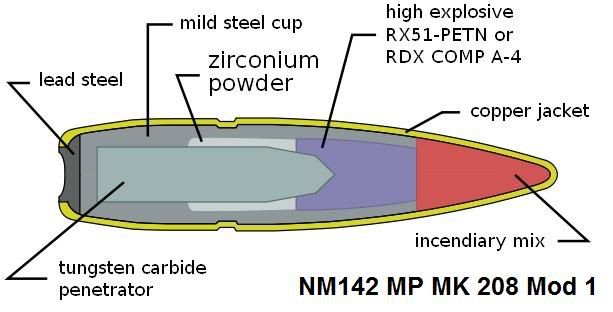
Typical of a modern HEIAP shell is the NM142 MP Mk 208 Mod 1 round designed for weapons such as heavy machine guns and anti-materiel rifles.
The primary purpose of these munitions is armor penetration, but unlike SLAP rounds (Saboted Light Armor Penetrator) which get their armor piercing ability from the propulsion of a 5.56mm tungsten heavy alloy bullet from a 7.62mm barrel using a sabot with much more energy than is usually possible from a 5.56mm round, HEIAP munitions use high explosives to "blast a path" for the penetrator. The special effect is developed when the round strikes the target. The initial collision ignites the incendiary material in the tip, triggering the detonation of the HE charge. The second (zirconium powder) incendiary charge will also ignite. This burns at a very high temperature, is not easily extinguished, and can last for 30 seconds.
The remaining element of the round is the tungsten carbide penetrator. This has a large amount of kinetic energy and will penetrate the armor as solid-cored armor piercing shot would. This will take some of the incendiary material through the armor. The MK 211 is claimed to penetrate up to an inch (25.4mm) of rolled homogeneous armor.
The triggering of the explosive charge is dependent upon the resistance of the target. If the target offers little resistance then the lack of frictional heating will prevent the incendiary from igniting and the high explosive from detonating.
Larger guns such as the British 30 mm RARDEN cannon fire APSE (Armour Piercing Special Effects) shells which are an armor piercing round with added HE effect.
This round is usually identified by a green over white paint tip mark. A rarer occurrence of a green–over red–over white paint mark scheme indicate the tracer version of this round. These tracer versions are usually only seen on cartridge feed belts in naval applications.
The headstamp on the casing can also help to identify the round as Raufoss and some common headstamps include, but not limited to: HXP89, WCC94, and FN91; or HXP, WCC, LC, or FN with different two-digit numbers as production year suffixes.
The round itself is essentially a 13 gram container. While possibly obtaining lower velocities than an ordinary round of it's kind would, in an ordinary case, the kinetic energy of the round has less importance than it's over-all function. This is becuase the round detonates on impact, both igniting the 4000 degree zirconium, setting off the C-4 explosive, the force of both of these more than compensating for any lack of energy in the propulsion, and also becuase both these explosions themselves send the carbon tungsten penetrater into the material at such a rapid velocity when combined with the initial kinetic energy that extra velocity while in flight becomes close to irrelevant. Considering the benefit of the explosive quality of the round and comparing it to the extra energy provided by the slight advantages conferred by a somewhat higher velocity, it's reasonable to assume that the extra material comes at a benefit rather than a deficit to the round.
The ratios of materials, in weight, is 4.6 grams of RDX, 2.2 grams for the zirconium, 3.2 grams for the lead steel, and 3 grams for the tungsten carbide penetrator.