








Radioisotope Thermoelectric Generator
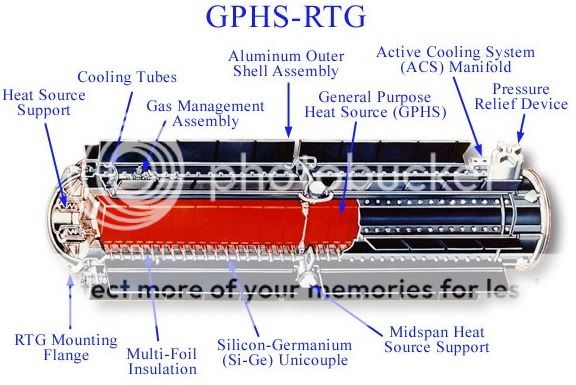
A Radioisotope Thermoelectric Generator (RTG, RITEG) is an nuclear electrical generator that obtains its power from radioactive decay. In such a device, the heat released by the decay of a suitable radioactive material is converted into electricity by the Seebeck effect using an array of thermocouples.
RTGs can be considered as a type of battery and have been used as power sources in satellites, space probes and unmanned remote facilities, such as a series of lighthouses built by the former Soviet Union inside the Arctic Circle. RTGs are usually the most desirable power source for unmanned or unmaintained situations needing a few hundred watts or less of power for durations too long for fuel cells, batteries, or generators to provide economically, and in places where solar cells are not viable.
A thermoelectric generator works off of the Thermoelectric effect, or a direct conversion of temperature differences to electric voltage and vice versa. A thermoelectric device creates a voltage when there is a different temperature on each side. Conversely when a voltage is applied to it, it creates a temperature difference (known as the Peltier effect). At atomic scale (specifically, charge carriers), an applied temperature gradient causes charged carriers in the material, whether they are electrons or electron holes, to diffuse from the hot side to the cold side, similar to a classical gas that expands when heated; hence, the thermally induced current.
This effect can be used to generate electricity, to measure temperature, to cool objects, or to heat them or cook them. Because the direction of heating and cooling is determined by the sign of the applied voltage, thermoelectric devices make very convenient temperature controllers.
Most RTG's, including the one in the MJOLNIR battle suit, use 238Pu which decays with a half-life of 87.7 years. RTGs using this material will therefore diminish in power output by 1 − 0.51 / 87.7 or 0.787% of their capacity per year. 23 years after production, such an RTG will have decreased in power by 1 − 0.523 / 87.7 or 16.6%, i.e. providing 83.4% of its initial output. Thus, with a starting capacity of 470 W, after 23 years it would have a capacity of 0.834 * 470 W = 392 W. However, the bi-metallic thermocouples used to convert thermal energy into electrical energy degrade as well; at the beginning of 2001, the power generated by the Voyager RTGs had dropped to 315 W for Voyager 1 and to 319 W for Voyager 2. Therefore in early 2001, the thermocouples were working at about 80% of their original capacity.
The RTG in the MJOLNIR Suit works at a watt output rate of roughly 2024 watts for 23 years, as it actively increases it's watt output during it's decay to match itself, resulting in a flat, steady watt rate for a period of roughly 23 years.
