
Welcome to Gaia! ::

The Armory

Back to Guilds


Tags: Armory, Weapons, Vehicles, Armor, Army 

Reply Hangar 1: Infantry Weapons/ Armor- And Attachment weapons
MA5B

Quick Reply

Enter both words below, separated by a space:

Can't read the text? Click here

Submit

Suicidesoldier#1
Captain

Fanatical Zealot

PostPosted: Thu Jul 22, 2010 6:37 pm


User Image


Weapon Name- MA5B
Round Type- 6.5mm Grendel Caseless
Over-all length- 28 inches
Barrel length- 25.5 inches KE
18 Inches HE
Weight- 5.6 lb (2.55KG) unloaded,, 8.4 lb (3.81 KG) with 100 rounds,
Rate of Fire- 60 RPM- 1000 RPM (Electronically controlled)
Semiautomatic HE
Feed Mechanism- Detachable Box Magazine KE
Undertube barrel for HE
Round Capacity- 100 rounds
4 + 1 for underbarrel tube
Effective Range- 600 meters
Range- 1200 m (Supersonic, Velocity 375 m/s, 548 Joules)
Accuracy- .75 MOA at 600 meters
3 MOA for HE
Accessories- Picanty Rail
Quick switch firing mechanism- Extra Trigger
Scope/Sights- Picanty Rail
Muzzle Velocity- 820 m/s- 7.8 Gram Projectile
Firing System- Telescoping Bolt and Ak-108
Miscellaneous/electronic information- The weapon is an electrically fired, automatic, battery powered, Hi-Cap, caseless 6.5mm caliber weapon.


Basic Information


The weapon is essentially, an electrically fired, automatic, battery powered, Hi-Cap, caseless 6.5mm caliber weapon. The weapon, removing the conventional gas operated system, relies on high electric power to ignite the primer and propellant of the next round, rather than a hammer using shock force, greatly reducing the size of the receiver area of the weapon. In addition to this, the electrically controlled loading and firing system greatly reduces the chance of a "cook-off", especially from a caseless round (although the caseless rounds used in the rifle are at a low chance of a cook-off due to their primer and propellant binder). The weapon is made almost entirely out of composite polycarbon synthetic materials, similar to that used in the P90, FN-Five Seven, and Ak-108 weapons. This material is cheaper to produce, lighter weight, and stronger than conventional stamped steel or wood, although harder to produce (specific shapes must be molded for each specific application rather than simply "Stamped out" or carved). The Barrel, chamber, and parts of the magazine are all made out of steel, and the screws and other likewise attachment devices on the weapon are high carbon galvonized iron. The wiring is of basic copper construction, coated in safety and waterproof plastic, as well as having heat and fire reducing waterproof seals and coverings on it, so that it may preform without many complications in a basic heavy environmental condition. The basic magazine is essentially a 100 round quadruple column 23 round stack magazine, which is both spring and gear powered to allow reliable feeding. The weapon also uses the counter-balance system found in the Ak-108, which vents excess gas and uses rebounding kinetic energy to send a counter weight backwards inside the rifle to balance the weapon. The gun is also technically incapable of jamming, although misfires and malfunctions are definitely possible. The weapon, as well, has two safeties; that is, a button which turns the weapon on and off, and another that physically slides the electrical ignition devices power connector away from it, causing the gun to be nearly physically impossible to fire pulling the trigger, literally physically disconnecting trigger from the chamber, disallowing it to complete a circuit. In addition to this, the basic safety system of the rifle leaves the next round intended to be fired outside of the breech, making it nearly impossible for "Cook-off's" to occur. The weapon also has three fire selectors- Semi-Auto, Burst, and Automatic. Semi-auto, obviously, sets the electrically controlled device to fire one bullet each time the trigger is pulled (the trigger completing the circuit, and then being released). The Burst Fire brings up the RPM display and a bullet count, that allows the user to punch in a series of numbers and scroll through the number list to decide how many rounds are to be fired and at what RPM. The default is at 3 rounds at 2000 RPM, although selectors between 2 and 10 rounds per burst and up to 3000 RPM are present (although nothing more than 2500 RPM is recommended). While the burst mode is theoretically capable of being hacked into to provide a mathematical unlimited bullet spray per trigger pull (100 rounds to empty the magazine) and theoretically can be hacked into to provide sustained automatic fire up to 3000 RPM, integrated computer controllers disallow the weapon to be fired at this rate, so that the weapon won't destroy itself. The Automatic Setting is automatically set at 900 RPM, although RPM distances between 60 RPM and 1200 RPM are achievable via electronic control. The magazine of course, feeds from the back, and there is roughly a 2 inch buffer zone from the ignition chamber and the wall of the stock (although this area is filled with recoil dampening material, and not a large amount of recoil is present due to the counteracting force of the countermass. As an added benefit, the rifle is equipped with a high grade, extremely wide but short 6 inch suppressor. Unlike a silencer, the round is not slowed down or stopped by the mechanism, still making the round Supersonic, and recognizable for roughly 100 yards. What the suppressor does do, however, is capture most the extra expanding gases, reducing the over-all volume of the round fired to the extent that ear protection is not required to fire the weapon (although ear protection may be required in close quarters combat with enemy unsurpressed weapons). While still loud, weapon firing is unrecognizable past 100 yards, compared to the miles that it can be heard in normal firing.

The Barrel is a heavy 25.5 inch polygonal with a 1 in 8.75 inch (222.25mm) 6 right hand turn groove. The barrel allows for extremely high accuracy, being capable of achieving .75 MOA at 1000 yards in fully automatic fire- the weapon is also extremely accurate as a result of it's extremely controlled firing system and almost absolute lack of recoil.

The under barrel grenade luancher fires standard 25mm x 40mm grenades similar to that in the XM25. It is essentially an underbarrel tube fed semi-automatic shotgun using 25mm x 40mm rounds.
PostPosted: Fri Sep 03, 2010 6:36 pm


Extended Information


Counter-Balance System


User Image

The rifle features a balanced system that functions along the lines of Newton's third law of motion, which states that for every action there is an equal and opposite reaction. This system uses a recoil-dampening countermass mechanism with two operating rods that move in opposite directions, thereby providing "balance". One operating rod, the upper, has a gas piston facing forward while the bolt carrier also has a gas piston. The gas tube at the forward end of the handguard is double-ended to accommodate the two rods. The enlarged gas tube cover of the upper handguard guides both rods in their travel.

When the rifle is fired, gas is tapped from the gas port to enter the gas tube, driving the bolt carrier to the rear and the counter-recoil upper rail forward. The critical timing of the reciprocating parts is accomplished by a star-shaped sprocket that links and synchronizes both components, causing both to reach their maximum extension, or null point where forces are exactly equal, at exactly the same instant. This is also electrically controlled and "Monitored", although purely mechanical in design. The felt recoil is therefore eliminated, enhancing accuracy and assisting control during fully automatic fire. As the felt recoil is virtually eliminated, the manufacturer claims that accuracy is enhanced, especially during burst fire. An enhancement of 1.5 to 2 times has been reported.

This is very similar to the Ak-107 and Ak-108 series of rifles produced, without the hammer.


Electric firing System

User Image

In operation the weapon operates on the electronic pulse action principle. The system uses a primer, a standard rifle primer combined hexogen, electronically-fired at 17.5 volts. +/- 2 volts, the upper and lower limits preventing fire from either stray currents or static electricity. The direct electrical firing eliminates the mechanical delays, problems of mechanical shock force, and typical moving parts associated with a hammer and the possibility of jams with an extraction system, allowing for high sustained rates of fire with little problems or exertion on the weapon itself. Electrical power for the rifle is provided by an internal .5 KG Lithium ion power cell which has a runtime life of roughly 10,000 rounds, and can be recharged either by removing the battery or by a direct attachment of the weapon to the power source (this of course with AC/DC adapter, as the weapon itself does not have one/the several it needs in order to save on weight of the weapon). The lithium ion battery present is considered to be the best in the application of the weapon, having a high energy retention when not in use, having the highest energy per weight ratio, and being frequently used and readily available to the public, as well as it's ability to take moderate abuse (such as in applications like Cellphones, labtops, and hybrid cars).


Material Composition

The weapon is made from roughly the same materials found in the P90 and Fn-Five Seven weapons, using high grade, light weight polycomposite polycarbon polymers. These materials are actually cheaper, stronger, and at a lighter weight for it's strength in comparison to basic materials such as stamped steel and wood, although more complicated to produce. The cost efficiency of the material is cheaper mostly due to the ability to fabricate the material rather than to find it, and in the fact that less man power is required to create and achieve the finished project (two steps compared to several for mining steel or chopping down trees for wood). The material is also composite, meaning that several lightweight materials, alloys, and plastics of differing flexibility and hardness can be used to achieve the end product rather than simply creating a "Super Material".

The stock is covered in a 1/8 inch thick black film of Impact gel, which increases the comfortability of the weapon and greatly reduces the nearly non-existent felt recoil. The same material is used on the grip, potential fore-grip, grenade launcher accessory, and sides of the weapon to increase the over-all comfort and felt recoil reduction of the weapon.


Magazine

The magazines are molded from a high-strength translucent polymer similar to what is found in the G-36 and XM8 rifle magazines. The magazine case allows for a lightweight, cheap, and flexible translucent material to view the rounds left inside the magazine. While not quite as rigid as steel, it is considered to be just as strong, if not more useful than standard steel constructed boxes.

The empty magazine weight is roughly .6 lb, or .28 KG. Fully loaded, with 100 rounds, the magazine weight is roughly 2.8 lb, or 1.28 KG. The magazine also holds two end pieces of steel.

The magazine is essentially a spring assisted electronically regulated magazine, which uses a system of interlocking gears which are powered by the weapons central power core, which allows for extremely high reliability. It is, however, permanently fixed to 100 rounds and relatively heavy compared to regular magazines.


Electronics

The customizable interface on the weapon displays, records, and allows basic electronic programmable control of the weapon. The interface is more or less a touch screen PDA, connected to the electric firing system, and wired correctly in order to accurately display the changed programmable features present in the weapon. The PDA is more a less a side-flipping device, that also connects to a much smaller screen which juts both the left and right side of the weapon. These screens, in turn, allow button control over the RPM of the current fire selector, and the amount of rounds per burst in case of the burst mode setting. They also present the amount of rounds present in the weapon; which works off a very simple method. The very sensitive mass calculator on the magazine calculates the weight of the current magazine, compares that to the relation of the base weight plus the projected estimated round amount and accurately relays the information to the PDA to be displayed on the device. Just kidding. The round counter works simply, as said before, by simply taking the entered predesignated amount (Auto-Pre-Designated when another magazine completely removed and then one added), and then subtracting each subsequent projected electrical impulse, indicating that normally a round would be fired, from the over-all entered total. While very basic, the contraption does work to provide an over-all basic understanding, in numbers, that's usually precise, in exactly how many rounds are left inside the weapon without the user having to actually take his eyes of his field of view or look at the magazine and estimate. This is of course, essentially based off of the FN Herstal Black Box round counter.


Scope

The scope is essentially an enlarged TA11J-308: 3.5x35 Trijicon ACOG® Illuminated Scope with Green Crosshair .308 Ballistic Reticle to basically fit a 4x40mm scope designation. The .308 ballistic reticles, which are pre-made and established to accurately follow the flightpath of the 7.62mm x 51mm NATO rounds to 1200 meters, reflect almost exactly the same flight path for the 6.5mm Grendel Rounds, with only a slight yet seeming unnoticeable difference. The primary marked difference between the standard 6.5mm Grendel rounds and the standard 7.62mm x 51mm NATO rounds, in ballistics flight path expectance, is basically the expected MOA, or accuracy, rather than the predicted flight path; although certain specific "Sniper Specific" 7.62mm x 51mm NATO ammunition carry a marginally different flight path and greatly increased MOA or accuracy in comparison to the .308 styled ammunition.

The scope of course, has a 40mm Thermal Vision addition which is expected to be added to the front, that allows the same view to be seen during the day time and night time with relative ease. The thermal addition also displays everything seen on the PDA in a HUD, including the round counter, current firing style, and RPM and burst amount selected.


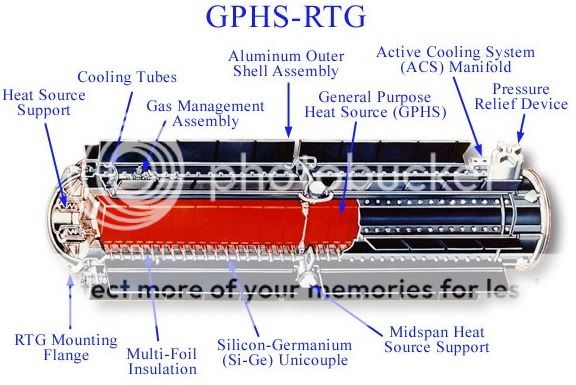
Radioisotope Thermoelectric Generator


User Image

A Radioisotope Thermoelectric Generator (RTG, RITEG) is an nuclear electrical generator that obtains its power from radioactive decay. In such a device, the heat released by the decay of a suitable radioactive material is converted into electricity by the Seebeck effect using an array of thermocouples.

RTGs can be considered as a type of battery and have been used as power sources in satellites, space probes and unmanned remote facilities, such as a series of lighthouses built by the former Soviet Union inside the Arctic Circle. RTGs are usually the most desirable power source for unmanned or unmaintained situations needing a few hundred watts or less of power for durations too long for fuel cells, batteries, or generators to provide economically, and in places where solar cells are not viable.

A thermoelectric generator works off of the Thermoelectric effect, or a direct conversion of temperature differences to electric voltage and vice versa. A thermoelectric device creates a voltage when there is a different temperature on each side. Conversely when a voltage is applied to it, it creates a temperature difference (known as the Peltier effect). At atomic scale (specifically, charge carriers), an applied temperature gradient causes charged carriers in the material, whether they are electrons or electron holes, to diffuse from the hot side to the cold side, similar to a classical gas that expands when heated; hence, the thermally induced current.

This effect can be used to generate electricity, to measure temperature, to cool objects, or to heat them or cook them. Because the direction of heating and cooling is determined by the sign of the applied voltage, thermoelectric devices make very convenient temperature controllers.

Most RTG's, use 238Pu which decays with a half-life of 87.7 years. RTGs using this material will therefore diminish in power output by 1 − 0.51 / 87.7 or 0.787% of their capacity per year. 23 years after production, such an RTG will have decreased in power by 1 − 0.523 / 87.7 or 16.6%, i.e. providing 83.4% of its initial output. Thus, with a starting capacity of 470 W, after 23 years it would have a capacity of 0.834 * 470 W = 392 W. However, the bi-metallic thermocouples used to convert thermal energy into electrical energy degrade as well; at the beginning of 2001, the power generated by the Voyager RTGs had dropped to 315 W for Voyager 1 and to 319 W for Voyager 2. Therefore in early 2001, the thermocouples were working at about 80% of their original capacity.

The RTG in the MA5 produces roughly 15 watts at it's initial power output, being used to power a .25 kilogram lithium ion battery, along with the PDA, Round Counter, Illuminated Display, and Scope. The rest of the power is of course used to power the active applications of the weapon, including the range finder, the active counting, and of course the firing of the rounds.

Suicidesoldier#1
Captain

Fanatical Zealot

Reply
Hangar 1: Infantry Weapons/ Armor- And Attachment weapons

 
Manage Your Items
Other Stuff
Get GCash
Offers
Get Items
More Items
Where Everyone Hangs Out
Other Community Areas
Virtual Spaces
Fun Stuff
Gaia's Games
Mini-Games
Play with GCash
Play with Platinum