





First, I am horrible at beginning these sorts of math proofs, so bare with me. It's much easier for me to post tables and explain what they mean instead of "speaking mathematics" as my 8th grade math teacher used to say.
This is a table of coin flips (rolling a 2-sided dice):

The x-axis (the number in bold along the top) represent the sum of the the coins (with heads being 1 and tails being 2.) The y-axis (in bold along the left side) represent the number of coins tossed.
Many should catch right on that this is in fact Pascal's triangle. This lead me to find the dice odds for any dice roll follows a similar pattern to Pascal's triangle. Allow me to explain:
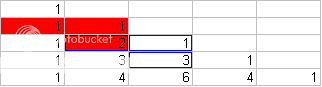
For those who don't know of Pascal's Triangle (or for those that need a refresher) this is the general pattern for the triangle. The two cells that are red in row 2 are added to form the red cell in row 3. The two cell that are in a blue outline in row 3 are added to form the cell in row 4 that has a blue outline. Basically, the sum of the two numbers forms the number below.
Now, seeing this pattern, I tried to apply it to a three sided dice (which does not exist, but the odds can still be calculated.) I've written it in the form of Pascal's Triangle, which means the x-axis will no longer represent the sum of the corresponding dice roll, but the definition of the y-axis still holds.
Assuming this for the three sided dice is wrong:

It turns out the number of digits above that must be added to generate the value below is the same as the number of sides of the dice. However, the zeros that are normally left out in Pascal's Triangle count when the number of sides on the dice are greater than 2
Here is the correct pattern (but not the correct x-axis numbers) for a three sided dice:

These numbers matched the hand calculations by hand of the dice odds. I believe this pattern arises from taking Pascal's triangle into more dimensions. There are a few other patterns found in these modified triangles, but I'll wait to see if what I found is correct (which I believe I am.)
